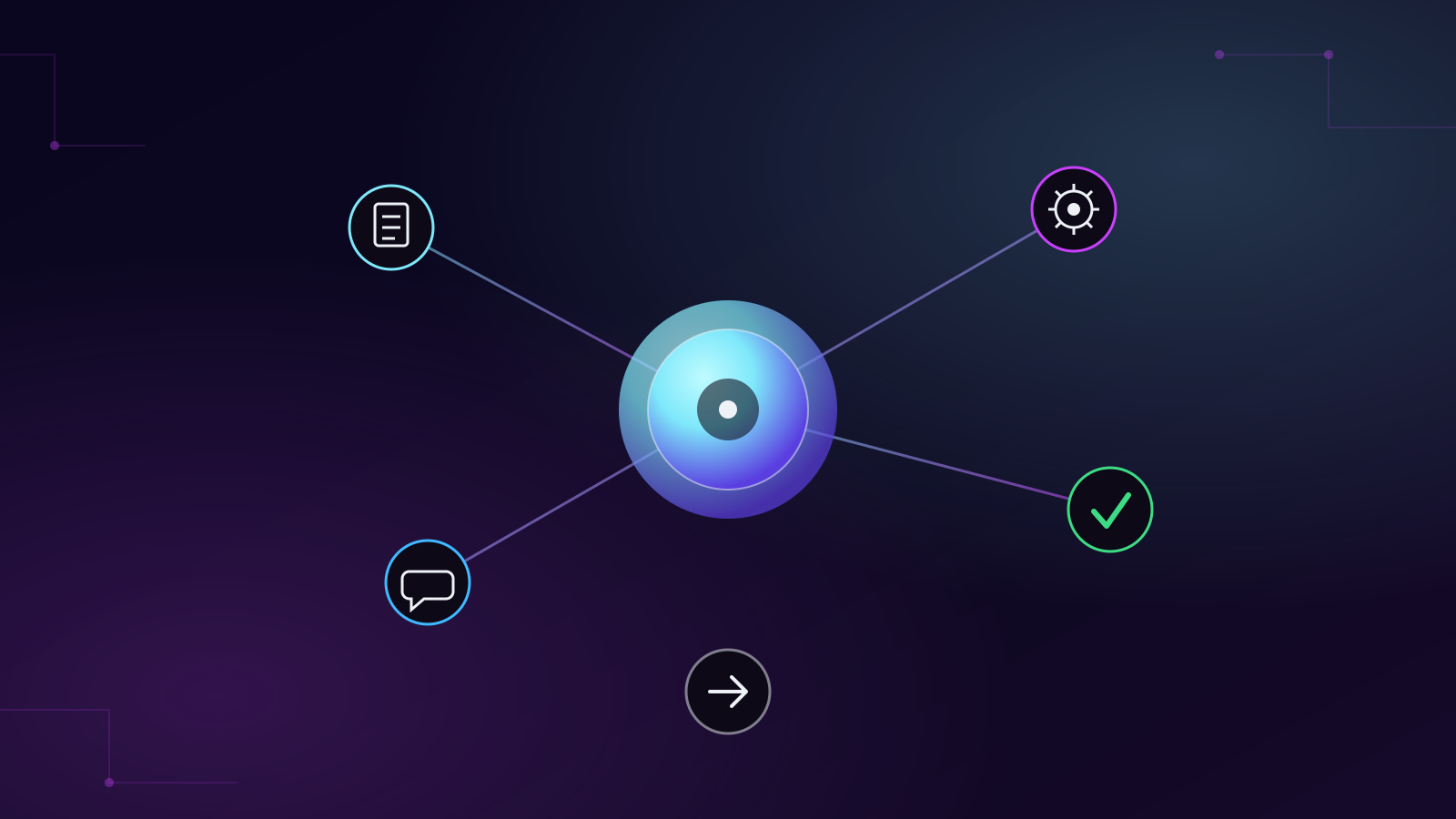
Businesses are no longer asking AI questions. They're assigning AI work.
AI Has Entered a New Era
For the past two years, businesses have primarily used AI as an assistant. You asked it a question. It gave you an answer. You reviewed the result. That model is changing rapidly.
The biggest shift happening in AI right now is the rise of Agentic AI. Instead of simply responding to prompts, AI systems are beginning to plan, reason, make decisions within defined boundaries, use tools, and complete entire workflows with minimal human intervention. This evolution is becoming one of the defining trends in enterprise AI adoption during 2026.
What Is Agentic AI?
Agentic AI refers to AI systems that can pursue goals rather than simply answer questions.
Instead of asking, "Write me an email," you might say, "Organise next month's client onboarding process."
The AI can then:
- Gather relevant information
- Draft emails
- Create documents
- Schedule meetings
- Produce reports
- Ask for clarification when needed
- Complete the workflow
Rather than acting like a chatbot, Agentic AI behaves more like a digital teammate.
Why Businesses Are Paying Attention
This isn't about replacing employees. It's about removing repetitive work.
Imagine an HR department. Instead of manually preparing onboarding documents, sending welcome emails, creating checklists, booking induction sessions, and generating contracts, an AI agent can coordinate much of the administrative workflow while HR professionals focus on people.
The same applies to finance, sales, marketing, customer service, compliance, operations and project management. The productivity gains could be substantial.
From AI Assistant to AI Co-Worker
Traditional AI waits for instructions. Agentic AI can work toward objectives.
For example, with traditional AI, you might ask it to "summarise this report." With Agentic AI, given the same report, the system can:
- Read the report
- Identify business risks
- Compare results against previous months
- Draft an executive summary
- Recommend actions
- Schedule a follow-up meeting
- Prepare presentation slides
The difference is significant. Businesses are beginning to shift from using AI for isolated tasks to integrating AI into complete business processes.
Why Governance Matters More Than Ever
The more responsibility AI receives, the greater the need for governance.
If an AI system can send emails, access customer information, generate reports, approve workflows, and interact with software, then organisations must establish clear rules around human oversight, decision boundaries, data access, audit trails, accountability and security.
This is why AI governance has become one of the fastest-growing priorities for business leaders worldwide. Industry guidance increasingly recommends defining approval controls, risk classifications, and clear operating boundaries before deploying autonomous AI agents.
The more autonomy an AI system is given, the more its governance needs to be designed before deployment, not discovered after an incident.
How South African Businesses Can Prepare
You don't need to build AI agents tomorrow. But you should begin preparing today.
Practical first steps include:
- Create an AI Acceptable Use Policy. Define how employees may safely use AI tools.
- Identify repetitive processes. Look for workflows that consume significant administrative time.
- Improve documentation. AI performs best when business processes are clearly documented.
- Train employees. Employees need to understand how to collaborate with AI rather than compete with it.
- Start small. Begin with internal workflows before expanding into customer-facing automation.
Agentic AI Is Changing the Role of Work
Every major technology shift changes how people work. Email changed communication. Cloud computing changed infrastructure. Mobile technology changed accessibility. Agentic AI is changing execution.
Instead of asking employees to complete every repetitive task manually, organisations will increasingly ask employees to supervise intelligent systems that complete much of the operational work. The human role becomes one of strategy, judgement, creativity, and oversight.
Final Thoughts
The conversation around AI is no longer about whether businesses should use it. That question has already been answered.
The real question is: how much work should AI be trusted to perform?
Organisations that establish strong governance, train their teams, and identify high-value automation opportunities today will be far better positioned to benefit from Agentic AI tomorrow. Businesses that delay may find themselves competing against organisations where AI doesn't just assist employees — it actively works alongside them.
How Okiru Can Help
At Okiru, we help organisations move beyond experimenting with AI to implementing it responsibly. Our services include:
- AI Readiness Assessments
- AI Strategy Development
- AI Governance Frameworks
- AI Acceptable Use Policies
- AI Training for Teams and Leaders
- Workflow Automation Consulting
Whether you're exploring your first AI initiative or preparing for an AI-driven future, we'll help you build a practical roadmap that balances innovation with governance.
Frequently Asked Questions
What is Agentic AI?
Agentic AI refers to AI systems that pursue goals rather than simply answering questions. Instead of responding to a single prompt, they can plan, reason, use tools, make decisions within defined boundaries, and complete entire workflows with minimal human intervention.
How is Agentic AI different from a chatbot?
A chatbot waits for an instruction and produces one response. An agentic system can break a goal into steps, gather information, draft documents, take actions across software, and ask for clarification along the way — behaving more like a digital teammate than a question-and-answer tool.
Is Agentic AI meant to replace employees?
No. The realistic use case is removing repetitive administrative work — drafting, scheduling, data-gathering, first-pass reports — so employees can focus on strategy, judgement, relationship-building and oversight.
Why does governance matter so much for Agentic AI specifically?
Because the more autonomy and system access an AI agent has — email, customer data, approvals, software integrations — the greater the potential impact if something goes wrong. Clear rules around human oversight, decision boundaries, data access, audit trails and accountability need to exist before autonomous agents are deployed, not after.
What should a business do first before adopting Agentic AI?
Start small. Create an AI Acceptable Use Policy, identify repetitive internal workflows worth automating, document those processes clearly, and train employees to supervise and collaborate with AI systems before expanding into customer-facing automation.
How can Okiru help with Agentic AI adoption?
Okiru helps organisations move from experimenting with AI to implementing it responsibly, through AI Readiness Assessments, AI Strategy Development, AI Governance Frameworks, Acceptable Use Policies, team training, and workflow automation consulting.