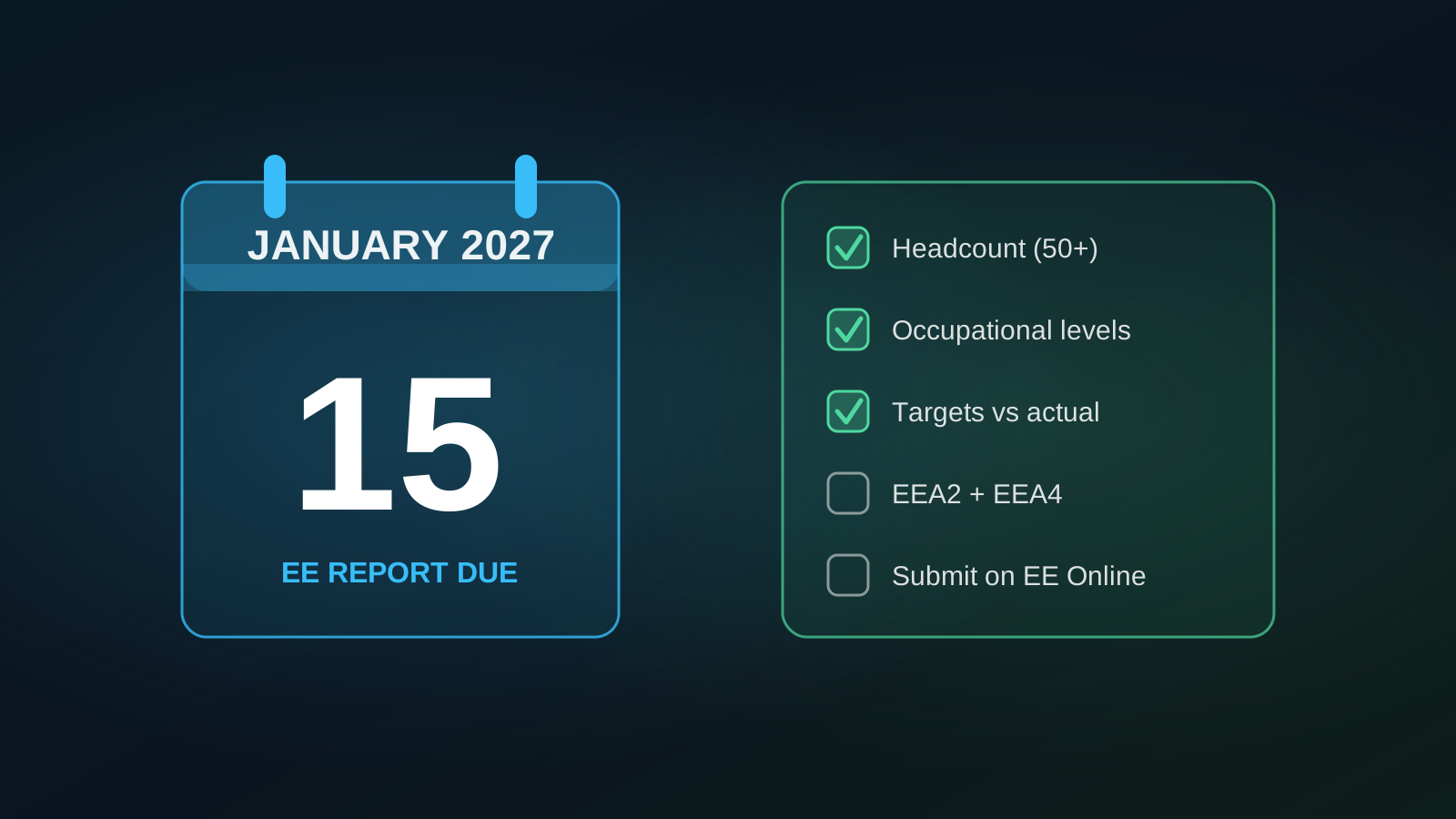
If your business employs 50 or more people, Employment Equity reporting season is open. The online window closes on 15 January 2027, in the middle of the festive shutdown, when HR and payroll teams are thinnest. This is what you need to know, and what to do now rather than in the second week of January.
Do You Have to Report?
Since the Employment Equity Amendment Act came into effect on 1 January 2025, a designated employer is, for most private businesses, simply an employer with 50 or more employees. Turnover no longer matters. Before the amendment, a business with fewer than 50 staff could still be designated because of its annual turnover. That is no longer the case.
Municipalities, organs of state and employers who are designated through a collective agreement, or who volunteer, are also covered. If you employ fewer than 50 people and are not covered in another way, you are not required to comply with Chapter III of the Act, which includes the annual report. If you reported in previous years, check that your status on EE Online reflects where you are now.
Key Dates for This Cycle
- Online submissions: opened on 1 September 2026 and close on 15 January 2027.
- Manual submissions: closed much earlier, on 1 October 2026, so for most employers online is now the only route.
- For comparison: the Department's deadline for the previous cycle was midnight on 15 January 2026.
These dates follow the same pattern as last year. The Department publishes reminders close to the deadline, so confirm the closing date when you log in to EE Online.
What You Submit
The annual report is made up of two forms:
- EEA2: the Employment Equity report, showing your workforce profile by occupational level, race, gender, nationality and disability, plus movements during the year.
- EEA4: the statement of income differentials, showing remuneration across occupational levels.
The report must be signed by the chief executive officer of the designated employer.
How the Sectoral Targets Apply
On 15 April 2025, the Department published five-year numerical targets for 18 economic sectors, along with new EE regulations and reporting templates. The current EE plan period runs from 1 September 2025 to 31 August 2030.
Two points matter most:
- You are assessed against your own annual targets. Your EE plan sets annual targets that move your workforce towards the five-year sectoral targets for your sector. Your report shows progress against them.
- Shortfalls need a reasonable justification. Missing a target is not automatically non-compliance, but you need a documented, credible reason. "We could not find candidates" with no evidence is unlikely to be enough.
The targets also include a disability target of 3% across sectors.
Why It Matters Beyond the Report
If you bid for work with any organ of state, section 53 of the Act matters. Designated employers must attach an Employment Equity compliance certificate (or a declaration, where that applies) to offers made to the state. The certificate is requested online after you submit your annual report, and the Minister issues it only if you have met your targets or given reasonable justification for any you missed. It is valid for 12 months.
In other words, a late or weak EE report can cost you tenders, not just compliance points.
A Practical Checklist
This is recommended practice, not a legal requirement. It is the order we suggest working in:
- Confirm your headcount and status. Count everyone the Act treats as an employee, not only permanent staff on payroll.
- Reconcile payroll to occupational levels. Most errors start here. Job titles drift, and the EEA2 needs every employee in the correct occupational level.
- Update demographic data. Check that race, gender, nationality and disability records are current. Disability is often under-reported because employees have not been asked in a way that makes them comfortable to disclose.
- Compare actual against your annual targets. Do this before you open the form, so there are no surprises.
- Write up your justifications. For every target not met, record what you did, such as recruitment drives, shortlists, offers declined and training, and why it did not close the gap.
- Prepare the income differential statement. Look at pay gaps across levels before you submit, not after.
- Consult as your plan requires, and keep a record. Make sure your EE committee or employee representatives have seen the numbers, and minute the meeting. A meeting assistant such as Fireflies.ai can transcribe and summarise it so you have dated evidence of consultation. Get everyone's consent before recording, and remember that EE discussions can touch on personal information protected by POPIA.
- Submit early and keep proof. Aim for well before the festive season, download your confirmation and keep it with your EE file.
- Request your section 53 certificate straight after submission if you do, or plan to do, business with the state.
If several people own different steps, put the checklist in a shared task tool, such as ClickUp, with an owner and a due date for each step. That way nothing waits until January.
EE and B-BBEE: Same Data, Different Rules
Employment Equity and B-BBEE are separate regimes. Submitting an EE report does not earn B-BBEE points, and a strong B-BBEE level does not prove EE compliance. But both rely on the same workforce data: occupational levels, demographics and skills spend. Getting that data right once saves you doing the work twice.
The Okiru View
Most EE reporting problems are data problems that surface at deadline time. We approach it through the Okiru Way: Structure your workforce data so payroll, occupational levels and demographics agree; Implement a reporting process with clear owners and evidence; and Optimise each year so targets, justifications and your B-BBEE scorecard draw on one source of truth. AI helps us extract, reconcile and validate the data. Our consultants remain responsible for interpreting the targets, the justifications and the advice. If you would like help before 15 January, get in touch with Okiru.
This article is general guidance based on the Employment Equity Act as amended, the 2025 regulations and published information on the current reporting cycle. It is not legal advice. Confirm deadlines on EE Online and take advice on your specific circumstances.
Smart data, smarter transformation.
Some links in this article are affiliate links. If you sign up through them, Okiru may earn a commission at no extra cost to you. We only mention tools we think are useful for the task described.